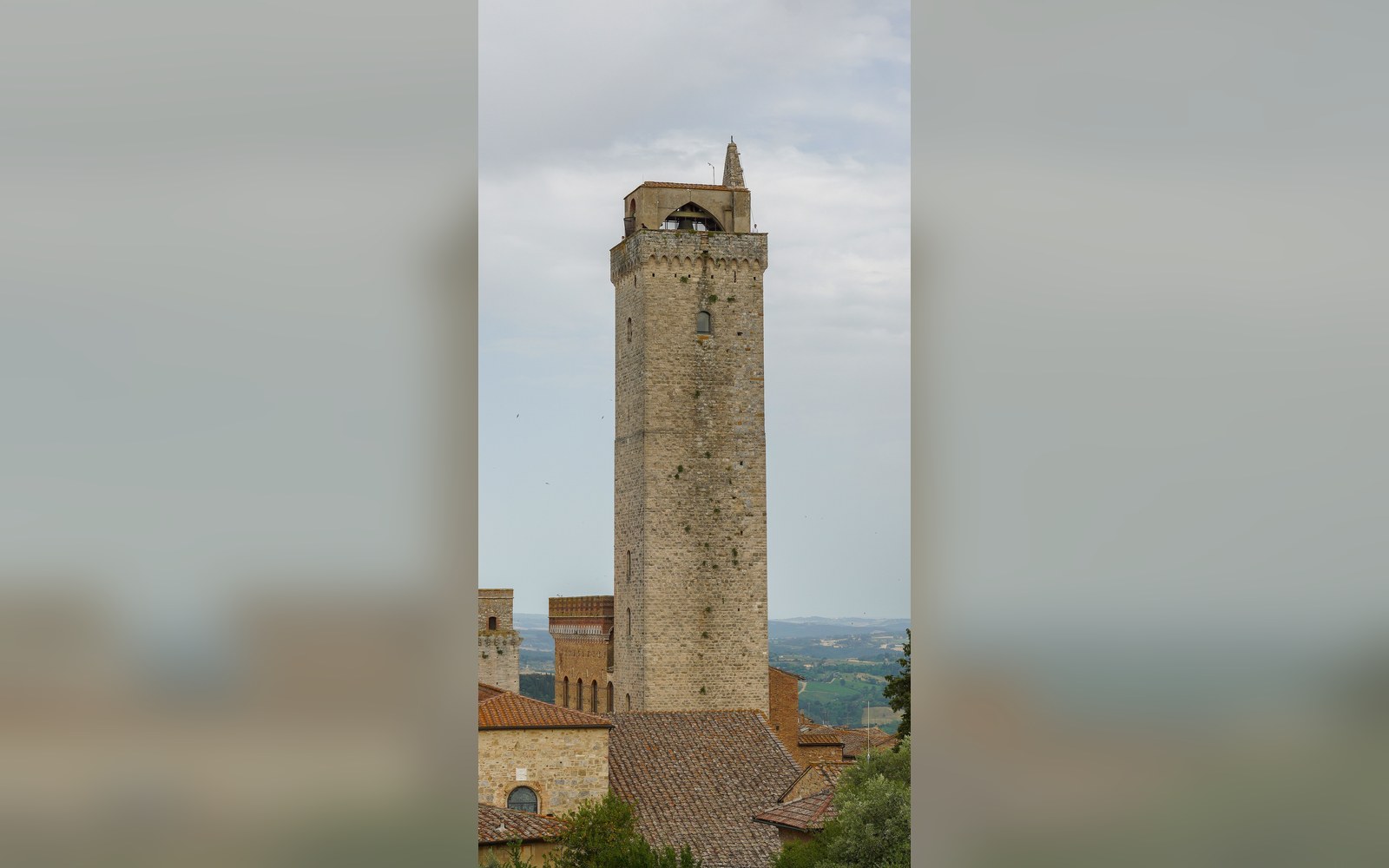
San Gimignano's surviving towers are overwhelmingly private — family monuments, statements of wealth and readiness, built by the Ardinghelli, the Salvucci and a dozen other clans competing in stone. Torre Grossa is the exception. Completed around 1311, it was raised by the comune itself, and its height was not incidental: at 54 metres it was decreed by statute to stand taller than any private tower in the town. The law made the politics explicit. Civic authority would be legible from every street and every field in the contado — the agricultural territory surrounding the town walls.
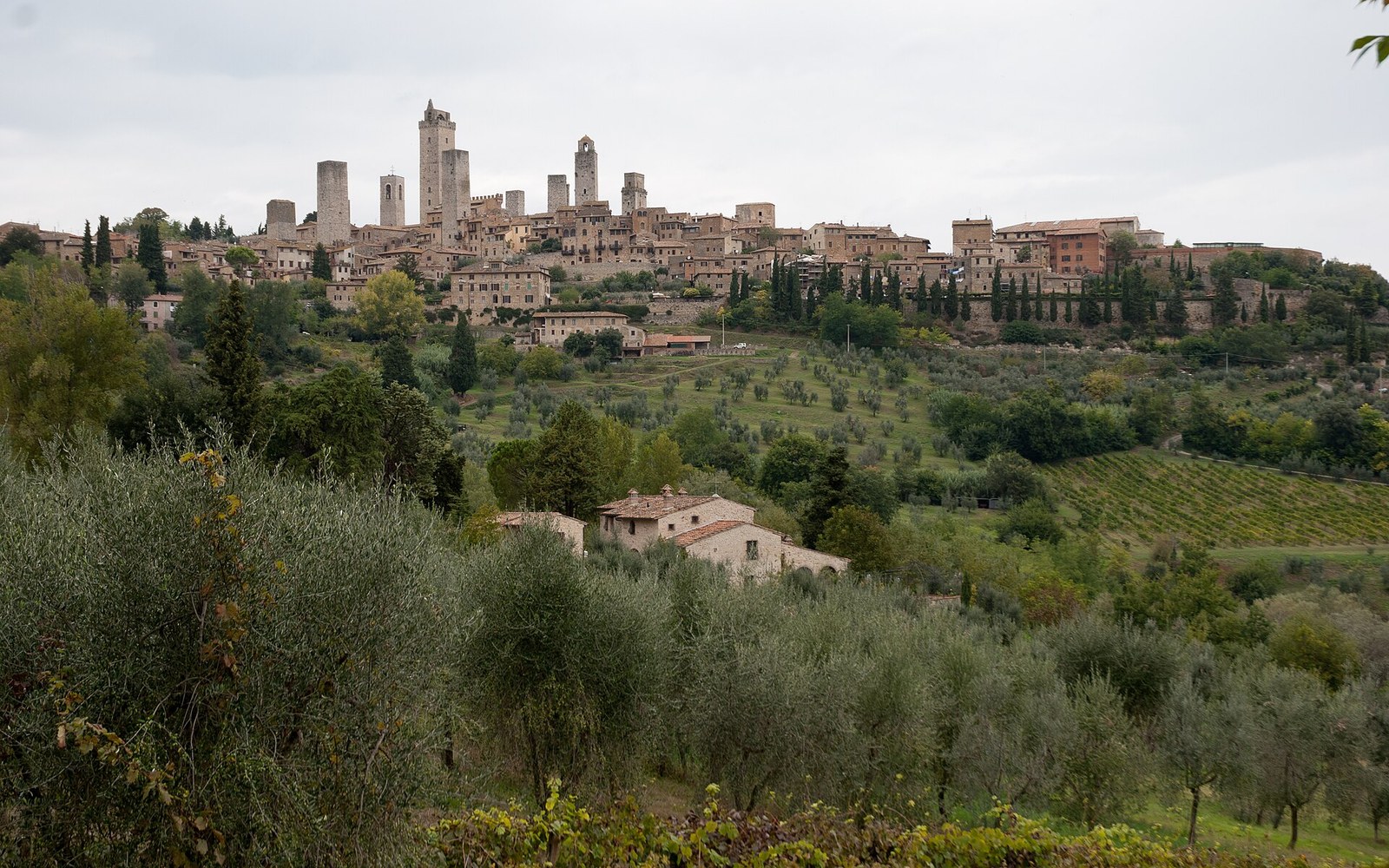
The tower rises directly from the Palazzo del Popolo, the seat of the commune's government, on the Piazza del Duomo. That attachment is the key distinction. A family tower stood over a family compound; Torre Grossa stood over the machinery of government. The podestà, the chief magistrate imported from outside the city to reduce factional bias, would have conducted business with the tower's silhouette framing every public pronouncement. Height here was not merely prestige — it was jurisdiction made vertical.
Construction and material record
The structure is built in the local travertine-inflected limestone characteristic of the Val d'Elsa, laid in regular courses that distinguish it from the rougher rubble cores of some private towers. The brickwork visible in upper sections reflects the same material sequence seen across Tuscan civic construction of the late Duecento and early Trecento: stone at the base where strength and prestige demanded it, brick higher up where the weight-to-cost calculation shifted. No master builder is named in the surviving documents, which is normal — civic building contracts of this period frequently record material purchases and labour costs without preserving the architect's identity.
Chronology
- c. 1311Torre Grossa completed
- Statutory height capcommune ordinances set private tower limit below 54 m
- 1353San Gimignano submits to Florentine rule; autonomous commune period ends
What the documentary record does confirm is the statutory dimension. San Gimignano's councils passed ordinances capping private tower height at a figure below the commune's own structure. This was not unique to San Gimignano — other Tuscan communes attempted similar legislation — but Torre Grossa is among the clearest surviving cases where the physical outcome of such a law can still be measured. The arms race in private towers that the commune was regulating had been running for well over a century before the civic tower was finished.
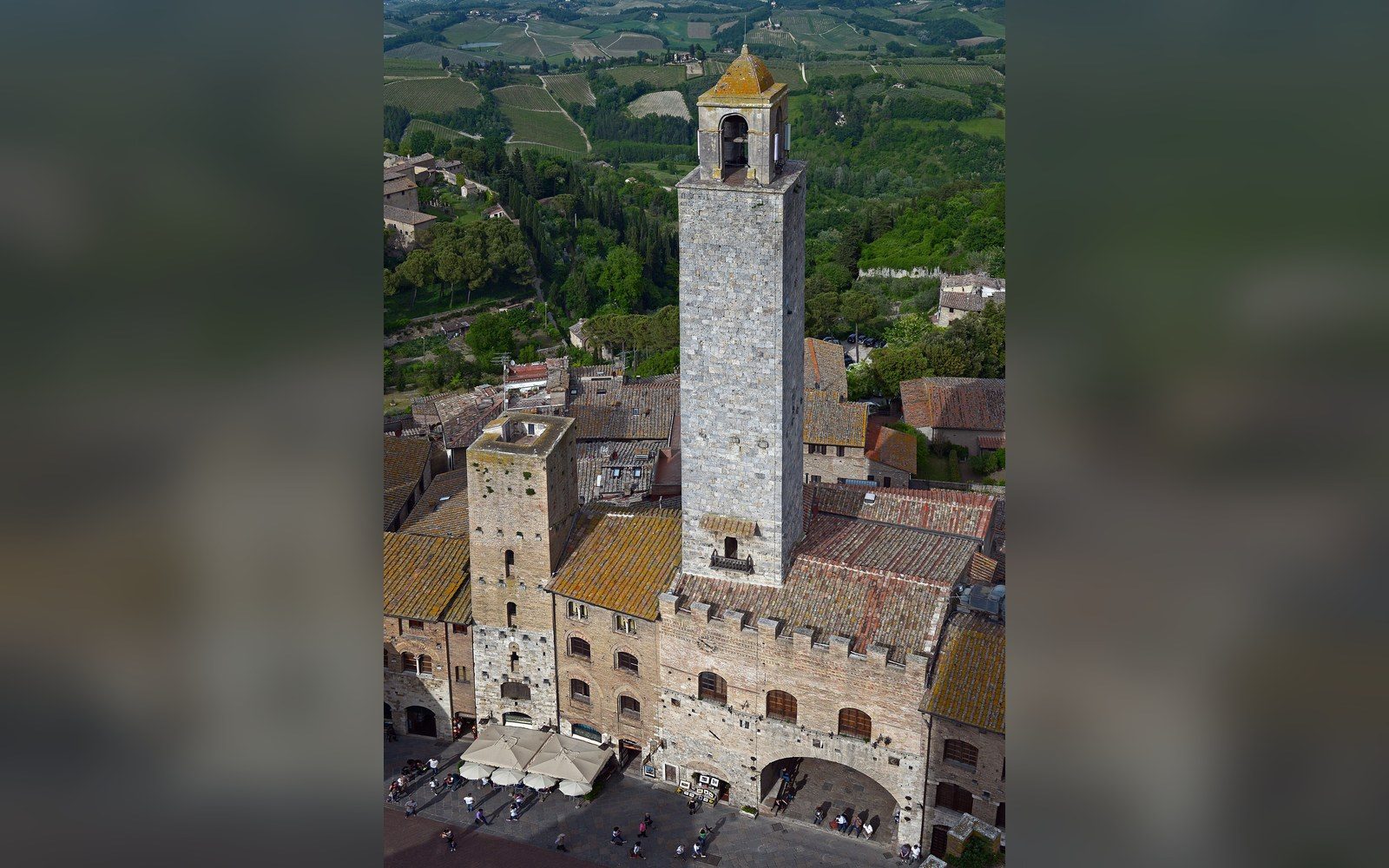
The bell chamber at the summit retains its original opening arrangement, designed to project sound across the town and into the surrounding hills. A civic tower that could not be heard was only half useful: the bell coordinated labour, announced assembly, and signalled emergency. Torre Grossa served all three functions, which is why its construction was a public investment rather than a vanity project.
Key measurements
| Item | What the record says |
|---|---|
| 54 metres | documented height of Torre Grossa, tallest surviving tower in San Gimignano |
| c. 70 | estimated peak number of private towers in the town |
| 14 | 14 number of towers surviving today |
What it proves about communal power
By 1300, San Gimignano was a prosperous comune on the Via Francigena, the pilgrimage road running from northern Europe to Rome, and its wealth showed in the density of private towers — perhaps seventy at the peak, of which fourteen survive. The commune's decision to cap that competition with a taller structure of its own reflects the broader dynamic of the Italian city-state at this moment: factional power being progressively subordinated, in theory at least, to collective civic institutions. Torre Grossa is the physical argument.
That argument was not entirely won. San Gimignano came under Florentine dominance in 1353, and the age of the autonomous commune — and of competitive tower-building — effectively closed. The towers that survived did so partly because demolition was expensive and partly because the political incentive to pull them down had passed: Florence had larger tools for asserting control than brick removal. Torre Grossa survived because it was useful, its bell still needed, its height still a reference point for the town's sense of itself.
The tower is among the best-documented examples of communal height regulation in medieval Tuscany, and it stands today in Piazza del Duomo, San Gimignano, comune of San Gimignano, province of Siena.