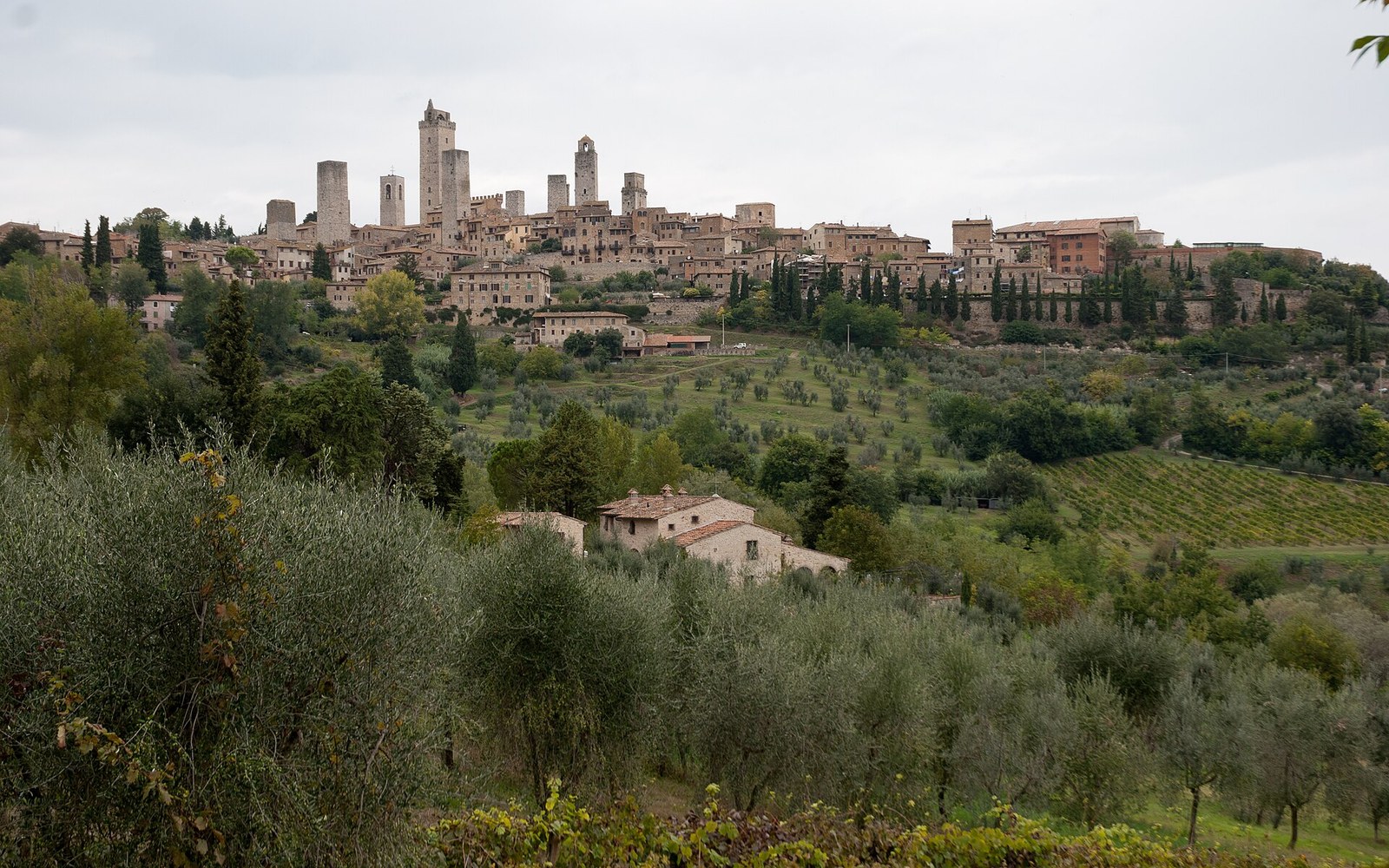
The skyline of San Gimignano, a hilltop comune in the Val d'Elsa northwest of Siena, reads like a frozen argument. Fourteen towers still stand above the roofline; in the twelfth and thirteenth centuries there were somewhere in the range of seventy. The number is approximate — chronicles and cadastral records disagree on the count — but the density is not in doubt. On a walled hilltop of modest area, the great families of San Gimignano stacked travertine and local sandstone as high as their credit and nerve would allow.
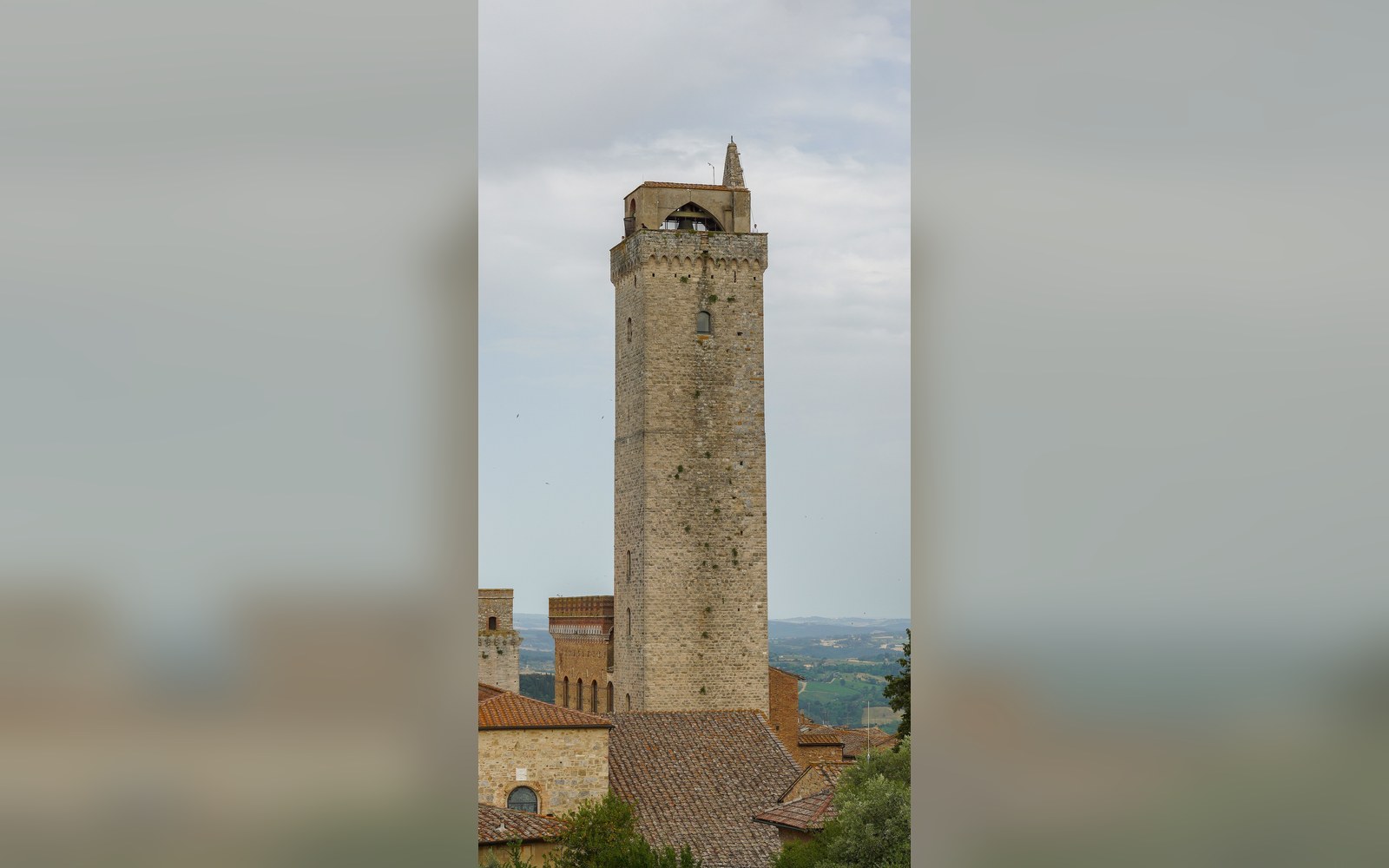
The towers were not a military arrangement. A single tower commands nothing tactically that the town walls did not already secure; a cluster of them, owned by rival clans within the same walls, commands nothing at all. What they expressed was something closer to continuous civic threat — the ability to rain projectiles on a neighbor's loggia, to shelter armed retainers above street level, to signal wealth that could be mobilised. The form was display and deterrence simultaneously, and the audience was not an external enemy but the family in the next quarter of the same town.
The families and the fabric
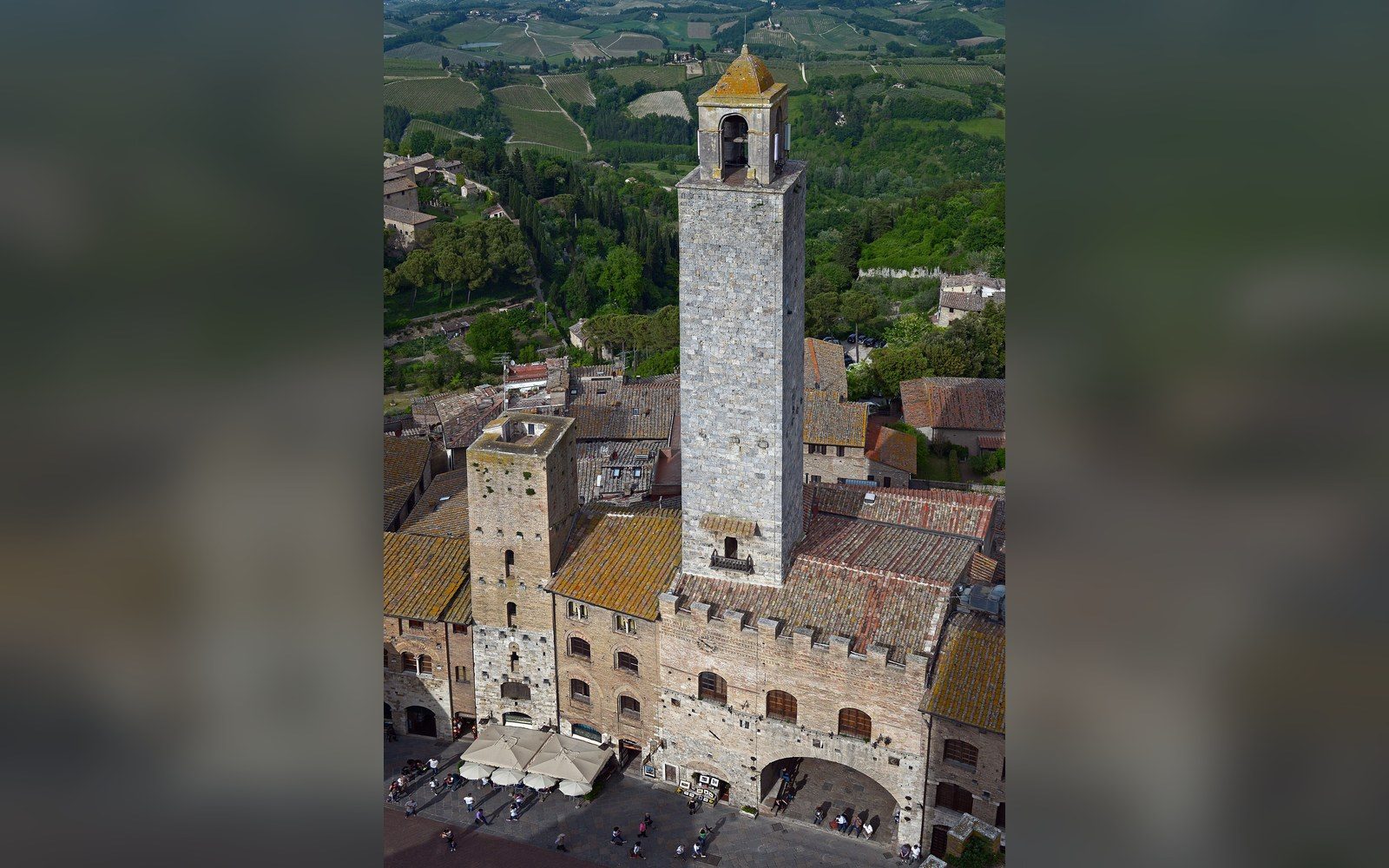
The principal tower-building families of San Gimignano were the Ardinghelli and the Salvucci, whose paired towers still face each other across the Piazza della Cisterna like interrupted insults in stone. The Ardinghelli aligned with the Guelf faction; the Salvucci with the Ghibelline. Medieval Italian factional politics — the split between papal and imperial loyalties that cut through nearly every commune — mapped directly onto the physical grain of the city, with rival tower clusters marking zones of control within streets that might otherwise seem indistinguishable. The towers were not metaphors for faction; they were faction's built form.
Chronology
- Late 11th–12th centuryprivate tower construction begins at San Gimignano alongside factional consolidation
- 13th centurycommune issues height restriction pegged to the Torre Grossa
- 1311Torre Grossa completed, Piazza del Duomo, San Gimignano; height approximately 54 metres
- 1348plague mortality reduces population and effectively ends the building competition
- 1990San Gimignano inscribed on the UNESCO World Heritage List (reference 550)
Construction followed the same logic visible elsewhere across Tuscany and Emilia: rubble and mortar core faced in dressed stone, the footprint narrow to minimize the ground-floor exposure to undermining, the shaft rising with slightly tapered walls to reduce load and add the visual illusion of even greater height. Timber floors within allowed storage and, in extremis, a vertical fighting position. The workmanship at San Gimignano is competent rather than exceptional; these are not the towers of a city flush with international trade revenue, like Pisa or Florence, but the towers of a prosperous secondary comune whose wealth came primarily from saffron cultivation in the surrounding contado — the agricultural hinterland — and from a position on the Via Francigena, the pilgrim and merchant road running from Canterbury to Rome.
That position mattered. Passing traffic meant passing income: tolls, hospitality, exchange. The Florentine merchant world pressed on the town, and Francesco di Marco Datini of nearby Prato left records showing the reach of commercial networks that touched even mid-sized Tuscan hill towns. San Gimignano's elite were prosperous enough to build in stone and ambitious enough to build tall. What they could not do, apparently, was stop.
The commune legislates height
At some point in the thirteenth century the commune of San Gimignano intervened. The mechanism was a height restriction: no private tower was to exceed the height of the Torre Grossa, the commune's own tower, which rises to approximately fifty-four metres above the Piazza del Duomo. The Torre Grossa — the name means simply the big tower — was completed in 1311 and was from the outset a deliberate statement of communal authority over family ambition. By making the public tower the legal maximum, the commune folded the prestige logic of the towers back on itself: private height became illegitimate the moment it surpassed the public.
Counted
This was not a unique response. Communes across northern and central Italy used sumptuary legislation and building ordinances to manage the tower competition, recognising that unchecked vertical rivalry was both a structural hazard and a symptom of the factional disorder that could destabilise civic government. At San Gimignano the restriction had the additional edge that the Torre Grossa was already very tall. Setting it as the legal ceiling was generous in height and firm in principle. Whether the ordinance was consistently enforced across the generations of building is another matter; the records are incomplete, and several surviving towers appear to post-date or circumvent it.
Tower record
| Item | What the record says |
|---|---|
| Towers standing at peak | approximately 70 (figure approximate; sources disagree) |
| Towers surviving today: 14 | 14 |
| Legal maximum height | height of the Torre Grossa (~54 m), established by communal ordinance |
| Principal rival families preserved in the fabric | Ardinghelli (Guelf) and Salvucci (Ghibelline) |
| Primary economic base of the comune | saffron cultivation in the contado; Via Francigena transit trade |
The fourteen towers that survived into the modern period did so for reasons that had nothing to do with the original owners' intentions. Demolition cost money and effort; towers that were structurally sound tended to be repurposed — as granaries, as dovecotes, as simple storage — rather than pulled down. The ones that fell did so largely through neglect, seismic damage, or deliberate dismantling by rival families after a political reversal. The fourteenth century's repeated plague outbreaks, beginning with the catastrophic mortality of 1348, reduced the population and the economic pressure that had sustained the building competition. The towers that stood in 1350 largely stand today, not as monuments to their builders but as the residue of a process that simply ran out of energy.
What the record shows
San Gimignano was inscribed on the UNESCO World Heritage ↗ List in 1990, cited specifically for its medieval townscape and tower architecture. The inscription frames the towers as an ensemble, which is historically accurate: no single tower here is architecturally exceptional, but the group is a rare survival of a social and political system that was otherwise normalised away. Elsewhere — in Bologna, in Florence, in Pavia — the towers were reduced systematically, either by communal legislation, by the consolidation of signorie, or simply by the building ambitions of later centuries that needed the stone. San Gimignano escaped large-scale later development, partly because its economic significance declined after the Via Francigena traffic redistributed and the saffron trade contracted, leaving the fabric intact through insufficiency rather than preservation policy.
The result is a cross-section of a specific moment in Italian urban politics: the period, running roughly from the late eleventh to the mid-fourteenth century, when the commune form was the dominant political structure, family competition was conducted partly in masonry, and the skyline was a live index of who was winning. All fourteen towers can be attributed, with varying confidence, to documented families. The Piazza della Cisterna ensemble alone preserves enough comparative material to read the rhythm of claim and counter-claim that shaped the hilltop. The stone is the argument; the argument is legible.