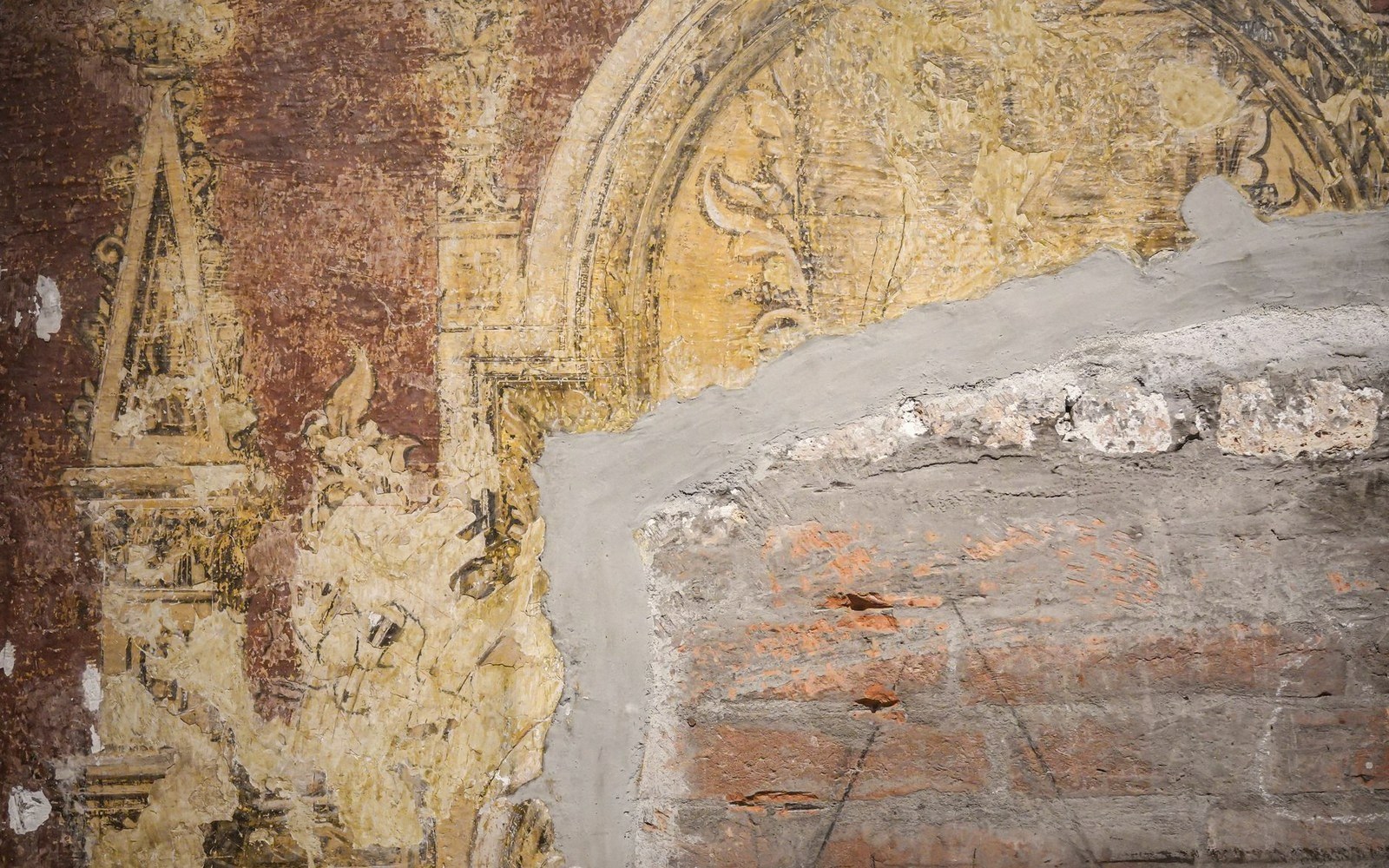
Buon fresco — "true fresco," as distinct from the secco technique of painting on dry plaster — works because of a reaction the painter cannot stop and cannot repeat. Fresh lime plaster (intonaco) is applied to the wall; the painter mixes pigments in plain water and brushes them onto the wet surface; as the plaster carbonates and hardens, it locks the pigment into the wall itself. There is no binding medium, no adhesive, no varnish. The colour becomes stone.
That chemistry is also a tyrant. Carbonation proceeds whether the painter is ready or not, and once the plaster dries, the surface is closed. Any paint applied afterwards — a secco, on a dry wall — will not fuse chemically and will eventually flake. The consequence is the giornata: the day's patch of fresh plaster, sized to exactly what a skilled hand can paint before the surface sets. Join lines between giornate are still visible in raking light across the great cycles in Siena, Florence and Assisi, and they are among the most reliable tools for reconstructing a painter's working sequence and speed.
Materials and their limits
| Item | What the record says |
|---|---|
| intonaco | the finish coat of fresh lime plaster on which painting takes place |
| arriccio | the rougher plaster coat beneath, prepared in advance; receives the sinopia |
| Lime-stable pigments | ochres, terre verte, carbon black, lime white; can be applied in true fresco |
| Alkaline-sensitive pigments | lapis ultramarine, azurite, most organic reds; applied a secco and at risk of loss |
What the painter could and could not use
Not every pigment survives alkaline lime. Lead white, azurite, and most organic reds are damaged or destroyed by the high pH of fresh plaster. The palette of buon fresco is consequently a constrained one: lime white from the plaster itself, iron-oxide reds and yellows (ochres), raw and burnt umber, terre verte, black from charcoal or bone, and the costly lapis-lazuli ultramarine — which, because it bonded poorly in wet plaster and was too costly to risk, was almost always applied a secco over the hardened fresco ground. That is why so much medieval ultramarine has flaked from walls where the underlying fresco has lasted perfectly: the blue was never truly bonded.
Before the intonaco went on, the design had to exist somewhere permanent. Painters prepared the rough plaster coat (arriccio) in advance and drew the full composition onto it in a red-ochre pigment called sinopia — a sinopia is essentially the thinking, made large and committed to the wall before colour was mixed. When Ambrogio Lorenzetti planned the Allegory of Good and Bad Government in the Palazzo Pubblico in Siena (completed 1339), the spatial complexity of those scenes — streets, countryside, dancers, merchants, armed men — had to be fully resolved at this stage. The pigment brush on wet plaster is not a medium for improvisation.
Survival and the question of quality
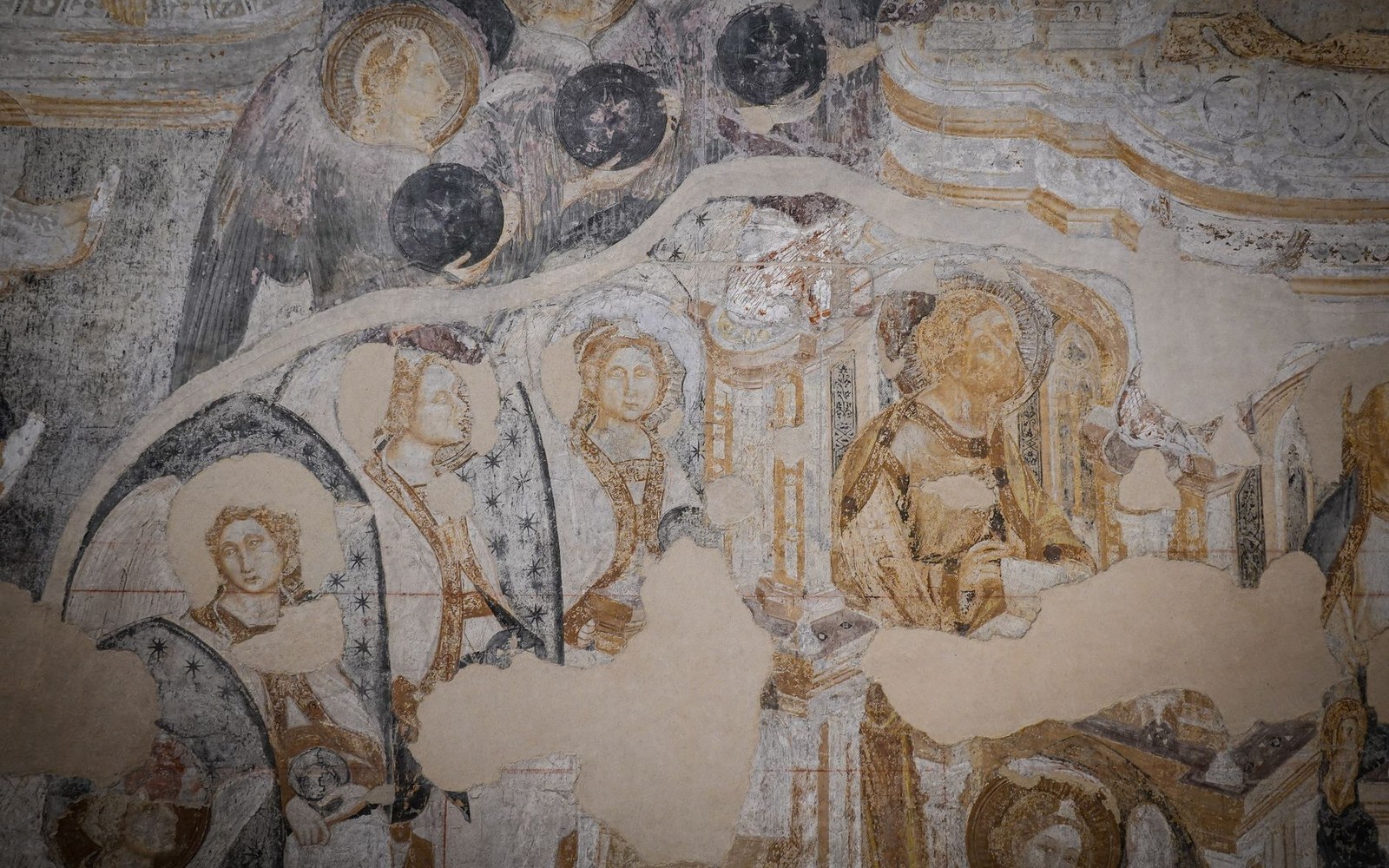
Buon fresco, properly executed, is among the most durable of painted surfaces; the pigment is the wall. It has outlasted panel paintings, manuscript illuminations, and embroidered silks from the same decades. The cycles in the Upper Church at Assisi, attributed in large part to workshop traditions surrounding Cimabue and Giotto, have survived structural damage, earthquake and light for more than seven centuries. What degrades fresco is moisture moving through the wall — salt crystals forming behind the surface as the plaster dries and wets repeatedly — and the failure of adhesion between the intonaco and the rough coat beneath it. Both problems are about the wall, not the paint.
Chronology of key works
- 1339Ambrogio Lorenzetti completes Allegory of Good and Bad Government, Palazzo Pubblico, Siena
- Late 13th centuryCimabue and workshop active in the Upper Church at Assisi
- Early 14th centuryGiotto and workshop active in Padua (Scrovegni Chapel, 1305) and Assisi
Secco additions are the first to go, which is why many medieval frescoes read as partially ghosted: the lime-fast colours remain, the organic-bound additions have vanished. What survives is not the painting as the painter left it; it is the chemically bonded fraction of that painting. Scholarship has had to adjust its reading of colour, tone and finish accordingly, understanding that medieval fresco interiors were often richer and more saturated than the stranded images now suggest. The giornata joins and the sinopia beneath are, in this light, not just technical evidence but honest witnesses — the part of the record that the chemistry agreed to keep.