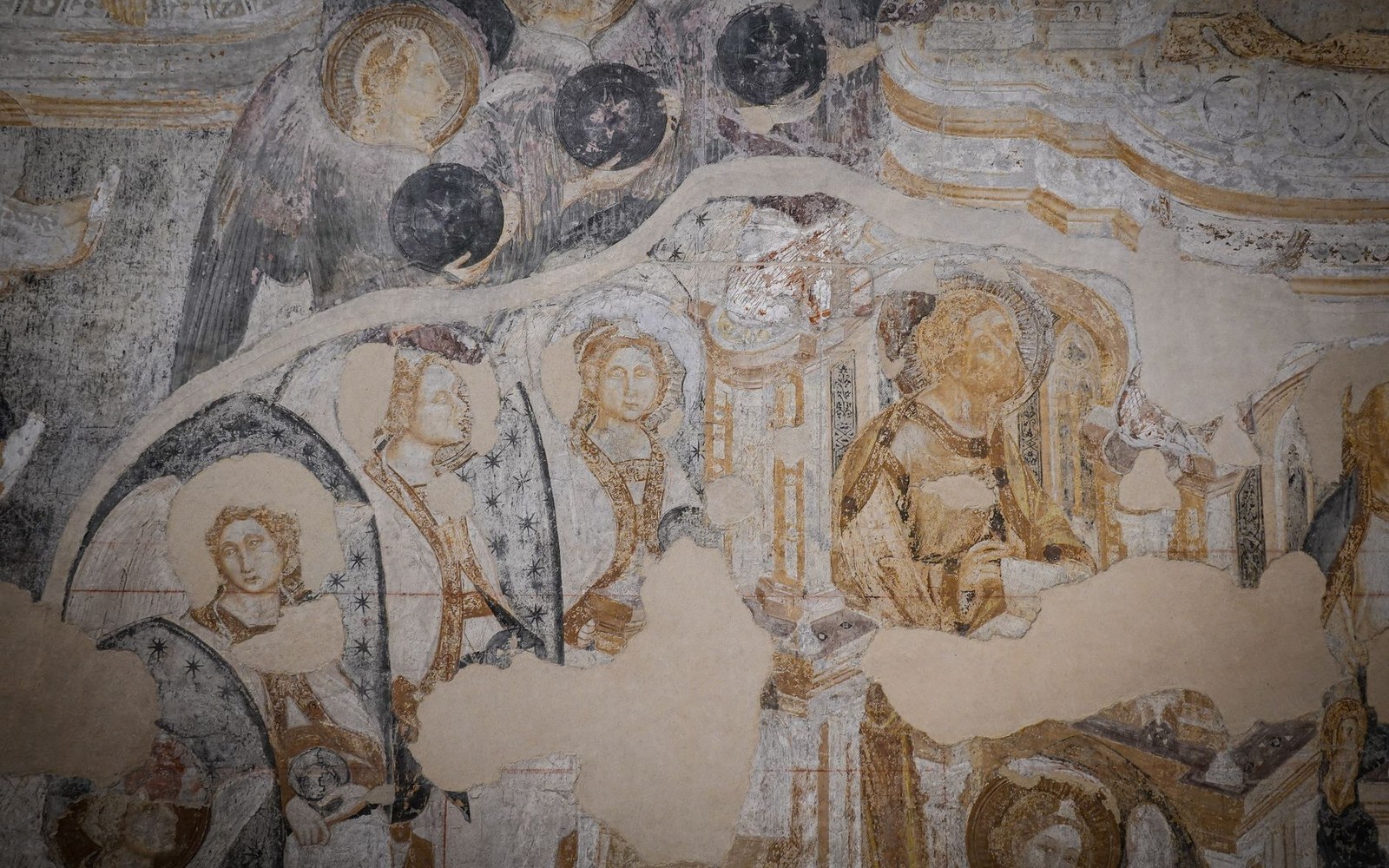
In buon fresco — pigment suspended in water and applied to freshly mixed lime plaster — the painter works against chemistry. As the plaster carbonates and sets, the pigment locks into the wall; once dry, the surface is insoluble and permanent. The constraint that makes this possible also enforces a strict rhythm: the painter lays only as much fresh plaster as can be painted in a single working day, before it hardens beyond use. That day's patch is the giornata (literally "day's work"), and it is the fundamental unit by which medieval and early Renaissance fresco campaigns can be read.
The join line as evidence
Every giornata is bounded by a physical seam where one day's plaster meets the next. In ordinary light these joins are nearly invisible — the painters were skilled at disguising them, and lime plaster takes pigment smoothly across a well-made edge. But in raking light, directed at a low angle across the surface, the relief of each join becomes visible: a shallow ridge or depression tracing the exact boundary of a day's work. Conservators and art historians use this technique systematically to reconstruct the sequence of campaigns across an entire fresco cycle, patch by patch.
The order of the patches is not arbitrary. Painters worked top to bottom and, within each register, from side to side in whatever sequence suited the composition. A painter working down the wall would lay sky and architecture first, then figures, because a later patch pressed against an earlier one leaves a cleaner join than the reverse. In Ambrogio Lorenzetti's Effects of Good and Bad Government in the Palazzo Pubblico in Siena — one of the most densely documented fresco cycles of the fourteenth century — the giornata joins have been mapped in detail, and they confirm this discipline: figures were inserted last, their contours cutting into the previously laid architectural background with a precision that implies careful pre-planning.
The painter's working sequence
- arriccio — the rough scratch coat of lime plaster on which the sinopia is drawn
- intonaco — the fine finish coat, laid fresh for each giornata
- sinopia — the red underdrawing on the arriccio, revealed when frescoes are detached
- giornata — the day's patch of intonaco, the unit of work and of later analysis
- arriccio and intonaco — the rough base layer of plaster, on which the sinopia is drawn, and the fine final layer of plaster laid fresh each day and painted on
The scale of individual giornate varies considerably. A patch of unbroken sky or plain architecture might be large; a face could occupy its own giornata, sometimes no bigger than a hand's span, because the flesh tones and the modelling of features demanded uninterrupted, unhurried work on fresh plaster. Speed and care traded against each other in the calculation of patch size, and that calculation tells us something real about the workshop's priorities.
What the joins reconstruct
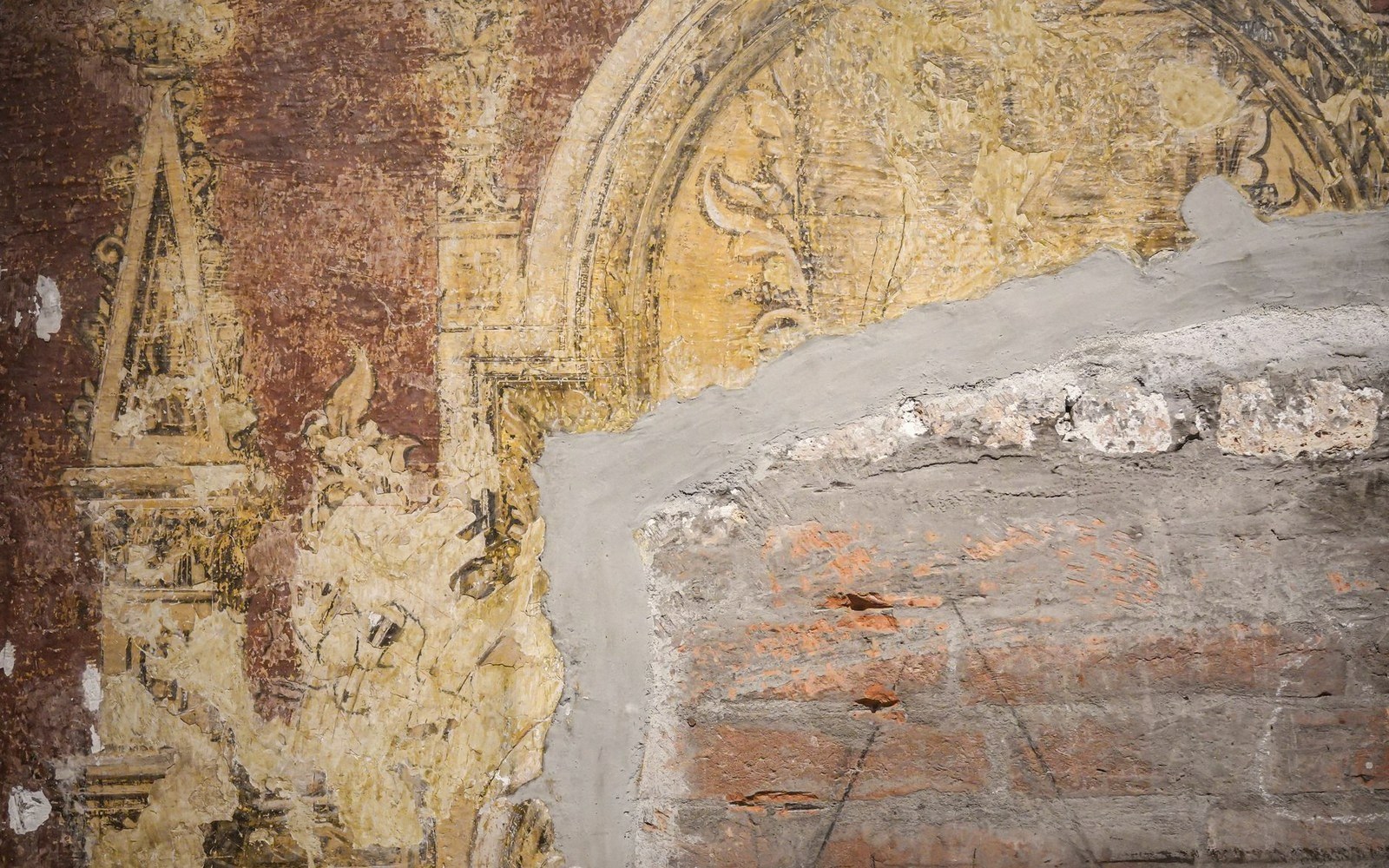
Reading the giornate of a fresco cycle is close to reading an excavation record: the joins establish sequence, and sequence establishes intent. Where a cycle has been damaged or detached from its wall — the late medieval frescoes in the Camposanto in Pisa were detached after the Second World War for conservation, exposing the rough arriccio layer beneath — the underlying sinopia, the red preparatory drawing on the rough coat, becomes visible. Together, the sinopia and the giornata joins allow scholars to compare the initial design against the final execution, and the comparison occasionally reveals significant changes of mind mid-campaign.
The giornata also functions as a signature of workshop practice. A master and his assistants typically divided the work by quality and prominence: the master reserved the faces and hands, sometimes a single important giornata per day, while journeymen laid the drapery and background. The physical evidence preserves this hierarchy. Patches across a cycle can be attributed to different hands not only by style but by the physical rhythm of the joins themselves — how large the patches run, how confidently the plaster is cut, how precisely a face giornata is integrated into the surrounding field.
Key cases in the record
- Ambrogio Lorenzetti, Effects of Good and Bad Government, Palazzo Pubblico, Siena — giornata joins mapped in modern conservation surveys
- Camposanto frescoes, Pisa — detachment during post-war conservation exposed sinopie, allowing comparison with final surfaces
- Raking-light survey methods now supplemented by structured-light scanning in some Italian conservation programmes
This reading of physical evidence is not inferential in the way that archival attribution can be. The join is there. In raking light, across the surface of a medieval wall, it is as close as art history comes to a time-stamp: not the date itself, but the day's work, its extent, its sequence, and often enough its authorship. The evidence is still accumulating. Systematic raking-light surveys of Italian fresco cycles, some now conducted with structured-light scanning, continue to produce new giornata maps — and each new map is an addition to the record of how, exactly, these surfaces were built.